
Should a tradesperson put prices on their website?
Every tradesperson has been told both things: “never show your prices, they’ll shop you” and “nobody phones a business that hides what it costs”. Both are half right. Here is how to tell which half applies to you, using three trade websites we built this year.
The argument for hiding prices is that every job is different, and a number on a page invites people to compare it with a cheaper one. The argument for showing them is that the person searching at nine at night with a leaking roof or a garage full of junk will not ring six firms — they’ll ring the one that told them roughly what to expect. Neither argument is wrong. The question is which kind of job you sell.
The test: can you price it before you’ve seen it?
If most of your jobs can be priced from a description — a van load of rubbish, a two-seater sofa, a standard collection — then hiding the price is pure friction. The customer knows the job is standard. Making them ask feels like a trick, and the firm that answers first gets the booking. If most of your jobs genuinely need a look — a roof, a rewire, a kitchen — then a fixed number would be a lie, and everyone knows it. The site’s job there is different: make the quote fast, not the price public.
Most trades are somewhere in the middle. Some jobs are standard, some are not. The mistake is picking one rule for the whole site.
When the price goes on the page
SM Waste Services clears rubbish across Glasgow and Lanarkshire. Almost every job fits one of five van loads, so the site publishes all five — £59 for an eighth of a van up to £259 for a full one — with the volume, the number of bags, the weight and the loading time for each, and a per-item list from a footstool to a corner sofa underneath. The booking flow then keeps the running price beside the form as you choose. Nobody phones to ask what it costs, because the answer is the first thing on the page.
What makes that work is not bravery. It is that the prices are fixed: labour, loading and disposal included, no weighing on the day. A published price that then grows on the doorstep is worse than no price at all. If you publish, publish the whole number.
When the quote goes on the page instead
Argyll Roofing in Paisley cannot tell you what your roof will cost from a search box, and the site does not pretend to. Instead, everything leads to a quote page with a structured form — what is wrong, which part of the roof, the best time to call — and a prefilled WhatsApp link for sending photographs of the problem. A photo of a slipped slate answers more questions than any price list could, and it lets a roofer quote from the van instead of driving out to look.
Block & Bolt does the same for home repairs in Glasgow: a quote request built around photographs and tick-boxes, so a mixed job arrives as a list that can be priced line by line rather than a paragraph that needs a call back. No prices on the site, and no “please call us” either. The price is a reply, and the reply is fast.
The middle path: publish the rule, not the number
Avram Metals collects scrap metal for free — that is the whole offer — but carrying a washing machine down three flights of a tenement is not free, and saying so on the doorstep would feel like a catch. So the site publishes the rule instead of a tariff: standard collection is free, a small labour charge applies only for heavy appliances from an upper floor, and it is confirmed before anything is booked. The customer knows where they stand without a price list existing at all.
For a great many trades this is the honest answer. You may not be able to say what the job costs. You can almost always say what is included, what would make it cost more, and whether they will be told before or after.
What to actually do
- List your last twenty jobs. Mark each one as “could have priced it from a text message” or “needed a look”. That ratio is your answer, not your competitor’s.
- Publish the standard ones, fixed. If a third or more were standard, put those prices on the site with what is included. Fixed means fixed.
- Make the rest a photo away. For everything else, a quote form that asks for photographs and the two or three facts that change the price. Never a bare “call us”.
- Say the rule where there is no number. What is included, what costs extra, and when they’ll be told. Written down, on the page.
- Put the phone number everywhere anyway. Some people will never fill in a form. That is fine; the form is for the ones who won’t phone.
If your current site does none of this and you are not sure where it sits, the Free Website Review looks at exactly this question first — because it is the one that decides whether visitors become enquiries.
More from In Practice
One page per town: how a local business gets found everywhere it works
Why a business that serves twenty towns needs twenty pages, why most area pages fail, and what a good one contains — from two Scottish sites with 37 of them between them.
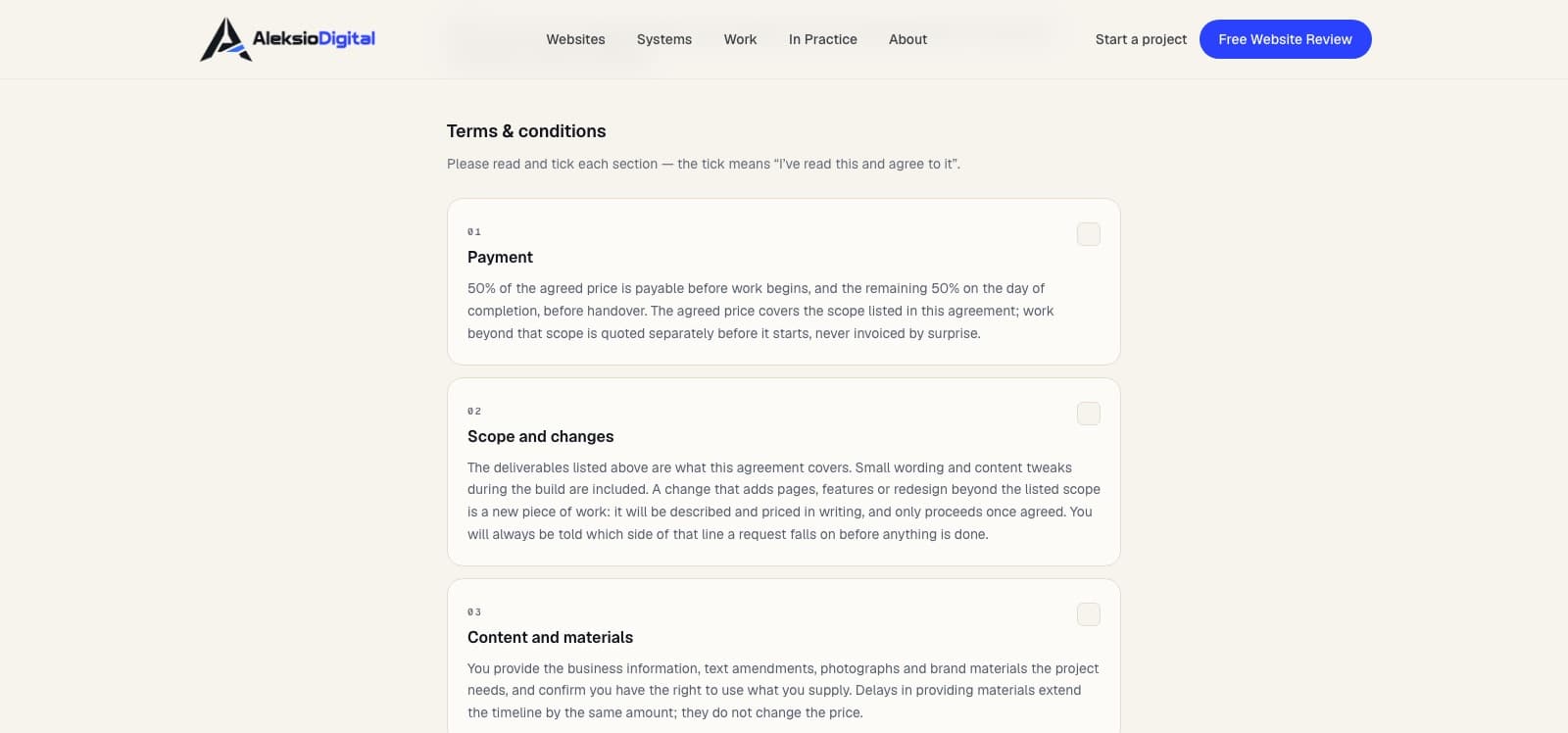
How we sign clients online — and why we built it ourselves.
The proposal-to-deposit system this studio runs on: a link the client ticks and signs on their phone, a branded PDF to both inboxes, the deposit paid by card. What it does, what it deliberately doesn't, and why we didn't just subscribe to DocuSign.
Want this applied to your site?
A Free Website Review is a straight assessment of what’s working, what isn’t, and what to fix first. No obligation.