
One page per town: how a local business gets found everywhere it works
Someone in Airdrie does not search for “rubbish removal Glasgow”. They search for “rubbish removal Airdrie”. If your website only has a homepage that says “covering Glasgow and Lanarkshire”, you have just lost that search to whoever bothered to write the page.
Local search works town by town. Google has learned that a person typing a place name wants a result about that place, and it rewards pages that are genuinely about it. A business that works across a region therefore has a choice: one page that lists thirty towns in a paragraph and ranks for none of them, or thirty pages that each rank for one. The second option is more work. It is also the entire reason two of our recent clients appear for towns their competitors have never heard of.
Why most area pages don’t work
Everyone has seen the bad version: the same page copied thirty times with the town name swapped in. “We provide rubbish removal in {Town}. Our {Town} team is ready to help.” Google’s guidelines have a name for these — doorway pages — and its systems have been good at spotting them for years. They add nothing a reader could not get from the homepage, so they rank for nothing. Worse, they can drag the rest of the site down with them.
The test is simple. Cover up the town name. Could this page be about anywhere? Then it is about nowhere.
What a page about a town actually contains
SM Waste Services has thirty area pages across Glasgow and both Lanarkshires. The East Kilbride one says which council it falls under and which postcodes, that it is about twenty-five minutes from the Wishaw base via the A725 and A726, that the housing is new-town semis with integral garages so garage clearances are the most common job, and that the Kelvin and Nerston industrial estates produce the commercial work. Then the same fixed prices as everywhere else, the services most booked there, questions people from East Kilbride have asked, and the towns on the same run.
Avram Metals collects scrap metal and has seven. Its East Kilbride page talks about cul-de-sacs and drives making household jobs easy, and the units on College Milton. Its West End page talks about tenement stairs. Same business, same service, different pages — because the towns are different, and the person who lives there can tell whether you know that.
None of this is clever. It is what the driver already knows after a year of doing the job. The work is getting it out of their head and onto the page, one town at a time.
The parts that do the ranking
- A title and heading that say the service and the town. “Rubbish removal East Kilbride”, not “Areas we cover”. Obvious, and skipped constantly.
- Local detail nobody could fake. Postcodes, the council, the drive time from your base, the kind of property, the jobs that are typical there. This is the part that separates a page from a doorway.
- The offer, in full, on the page. Prices or the pricing rule, what is included, how to book. Do not send them back to the homepage to find out.
- Links to the towns nearby. Someone in Hamilton is also someone in Blantyre or Larkhall. Each page should point to its neighbours and to the services relevant there.
- Structured data that lists the areas. Behind the page, the business’s structured data names every town it serves, so search engines read the service area the way a person would. Both sites above do this.
How many pages, and which towns
Only the towns you genuinely work in and can write something true about. Seven honest pages beat thirty hollow ones. Avram’s site has an index that says so directly: where an area has enough of its own detail, it gets a page; where it doesn’t, it is listed and you are invited to ask. That is the right instinct. Add a page when you have done enough jobs in a place to have something to say about it, and not before.
What to do this month
- Write down every town you have worked in during the past year, with a rough count of jobs. The ones with a handful or more are your list.
- For each, answer five questions: what kind of property, what jobs are typical, what is awkward about access, how far it is from you, and what people there have asked. That is the page.
- Give each page the town in its title, its heading and its address. Then link it from an areas index and from its neighbours.
- Put the whole offer on every one. Prices, what is included, how to book.
- Keep the homepage for the home town. It should still say where you are based and lead with the place most of your work comes from.
If your site already lists towns but has no pages for them, that is usually the single biggest gap between the search traffic you get and the traffic you could have. It is also where our SEO service starts.
More from In Practice
Should a tradesperson put prices on their website?
When publishing prices wins you work, when it costs you work, and the middle path most trades actually need — with three live Scottish trade sites as the evidence.
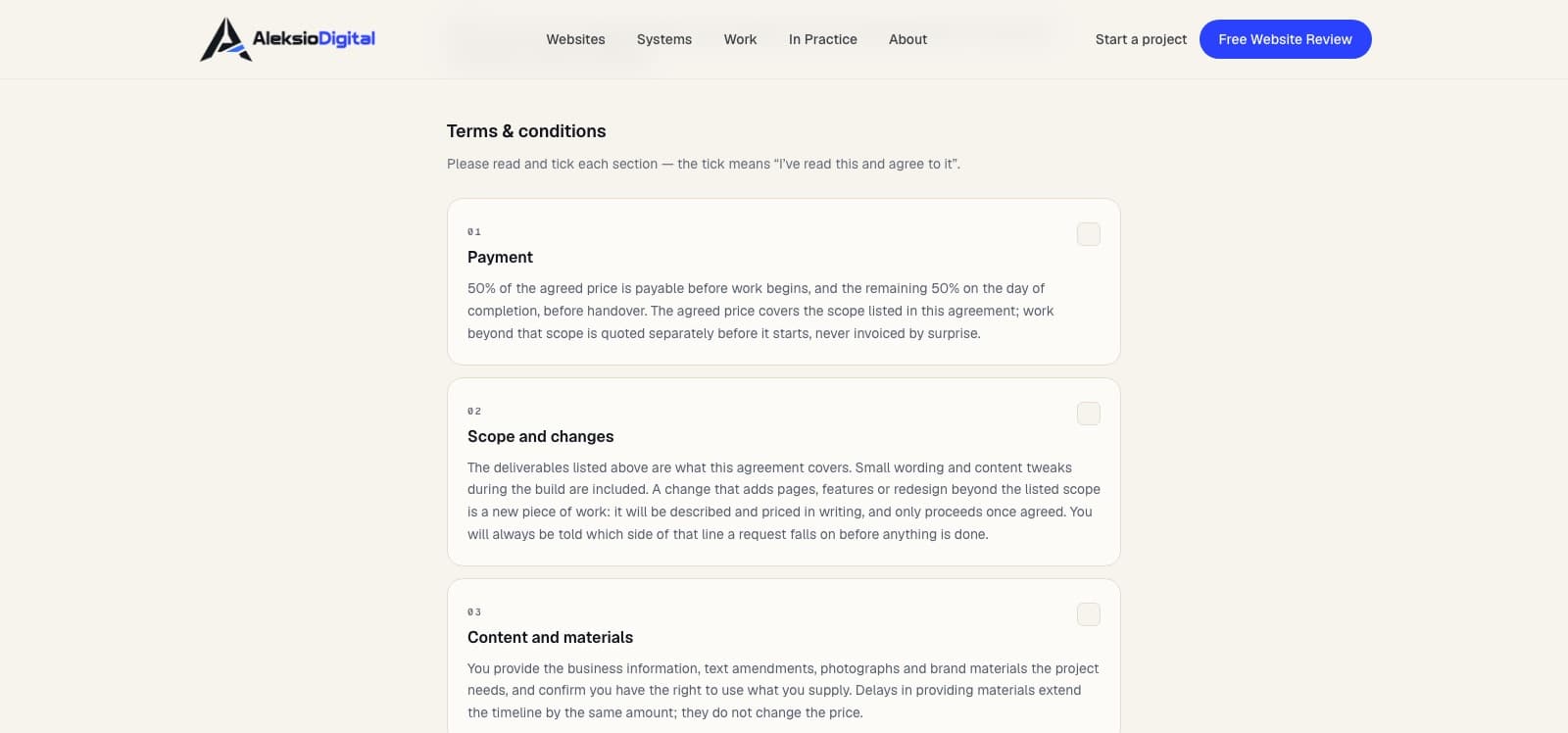
How we sign clients online — and why we built it ourselves.
The proposal-to-deposit system this studio runs on: a link the client ticks and signs on their phone, a branded PDF to both inboxes, the deposit paid by card. What it does, what it deliberately doesn't, and why we didn't just subscribe to DocuSign.
Want this applied to your site?
A Free Website Review is a straight assessment of what’s working, what isn’t, and what to fix first. No obligation.