
Trades & home services
Websites for trades and home services.
Most trade websites collect a name, a number and “please call me back”. The job is still unpriced, and so is the next one. The useful version collects the job itself.
What actually makes this hard.
Quoting trade work needs detail a text box never captures: what is broken, how bad it is, what floor it is on, whether anyone is living there, and whether the door is wide enough to get a ladder through. Without that, quoting means a phone call, then often a visit, before you know whether the job is even worth doing.
The second problem is who you are being compared against. A national franchise with a call centre looks bigger than a four-person crew on a website, right up until the customer discovers nobody there knows their street. A site for a local trade has to make being local and being small read as advantages, because they are.
The third is that your customer is almost always on a phone, often standing in front of the thing that needs fixing. Everything follows from that.
Built for this industry
A real one, live, documented in full.
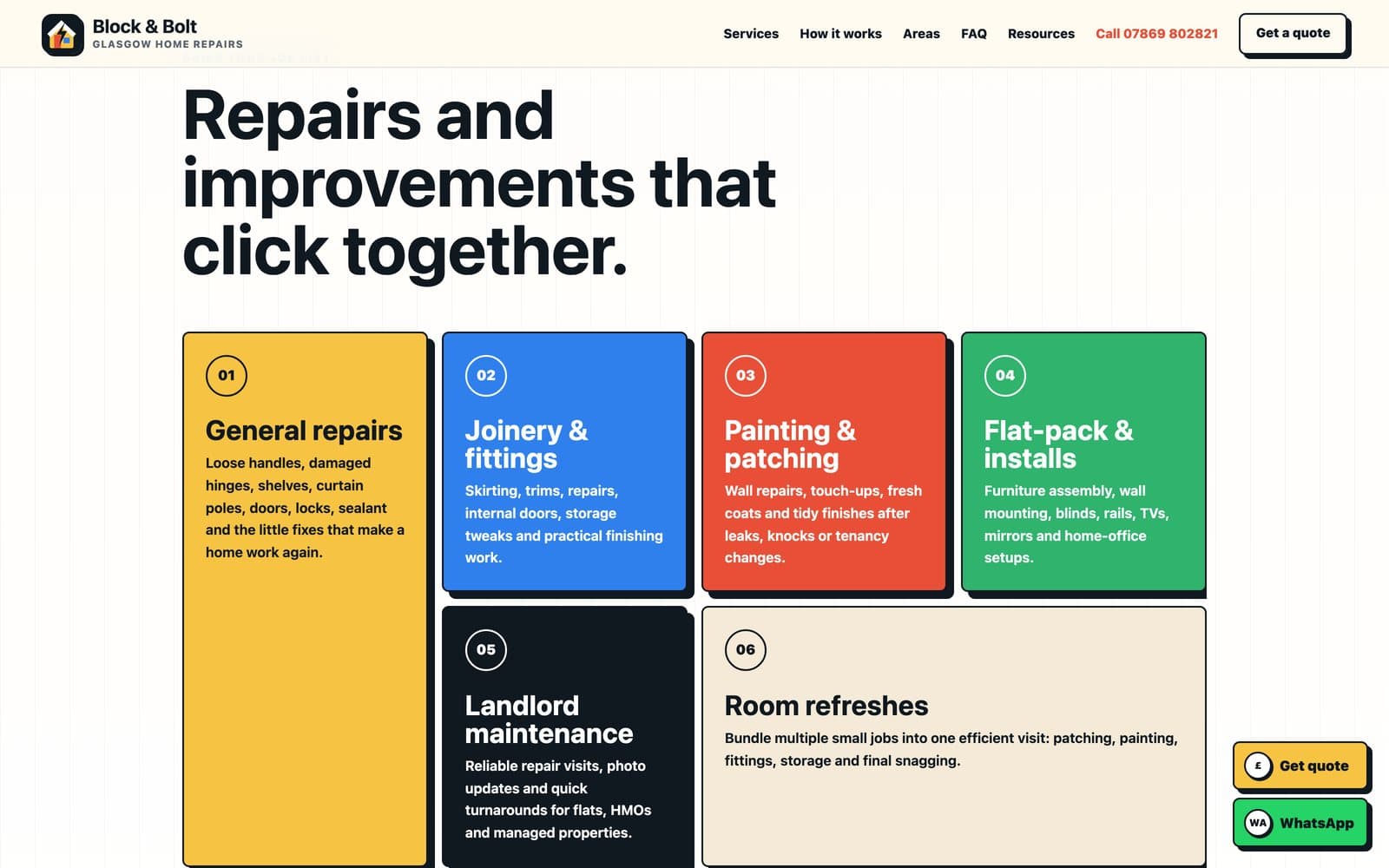
A four-person Glasgow home-repair crew, with a quote request that asks for photographs instead of a phone call.
What these projects need
The parts that tend to earn their place.
- 01Photo-led quote intake
- Let people show you the job from the phone in their hand. A photograph answers questions a form cannot, and it is the difference between quoting from the office and driving across town to look.
- 02Itemised job types
- Tick boxes rather than prose. A mixed job arrives as a list you can price line by line, instead of a paragraph you have to interpret and then ring back about.
- 03Access and property questions
- Flat or house, ground floor or third, occupied or empty. These decide whether a job needs one person or two, and asking up front is the difference between a quote and a guess.
- 04One tap to a human
- A call button and WhatsApp that stay reachable on every screen. Plenty of trade customers will never fill in a form, and losing them to a contact page is an unforced error.
- 05Landlord and agent work, treated separately
- Letting agents and property managers buy differently from homeowners — repeat work, tenant access, photo evidence, invoices. If that is a market you want, the site has to say so.
Not every project needs all of this. Which parts earn their place is what the first conversation is for — and the honest answer is sometimes that a straightforward website is enough. Here’s how to tell.
Before you ask
The questions that usually come next.
Straight answers on time, money and what you end up owning.
See all the questions01How long does it take?
A smaller website is usually about a week, measured from the point everything is ready — your text, photos and any brand assets in hand. Custom systems like booking or quoting tools take up to four weeks. In practice the honest variable is how quickly content comes back; that stretches timelines far more often than the build does.
02How does payment work?
Half up front to start the work, and the remaining half on the day the site goes live. Nothing in between, and no charges you haven't already seen on the quote. Ownership transfers with that final payment.
03Do I own the website?
Yes — outright, on final payment. That covers the design, the code written for your project and your content. Your domain is registered in your name, so you control the address itself and can take it elsewhere whenever you like. The underlying open-source frameworks stay under their own licences, as they do for any website. The only thing kept back is the right to show the work here as a case study.
04Can I update the site myself?
Sites here are hand-built rather than assembled in a page builder, so there is no admin panel by default — changes come through me. Small tweaks are covered by the care plan, and where you'll be updating something regularly, I build a proper interface for exactly that. If managing all your own content day to day matters to you, say so at the start: it's a reasonable thing to want, and it changes how the site should be built.
05What does hosting cost after the first year?
The first year of hosting is included. After that it's £65 a year for hosting on its own, or £180 a year for a care plan — hosting plus small tweaks and ongoing updates as you need them. Your domain renews separately and stays registered in your name. There's no obligation to take either: you own the site and can host it wherever you want.
06Do you outsource the work?
No. Every project is handled directly by George, from the first conversation through to launch. There's no account manager in between and no work passed to a third party.
Not your trade?
Tell us how the work actually comes in.
What happens between an enquiry arriving and a job being priced is usually where the useful work is. Describe that and we’ll come back with a scope and a straight answer on cost.