
When a website isn't enough
A brochure website tells people what you do. At some point, for some businesses, that stops being the constraint — and more design won't help.
There's a point a lot of growing businesses reach where the website is fine and the business still feels stuck. Enquiries come in. Then someone spends an hour on the phone establishing the same twelve facts they established yesterday, types them into a spreadsheet, works out a price by hand and emails it over.
That's not a website problem. Redesigning the homepage won't touch it.
The question that separates the two
Ask what happens after someone gets in touch. If the answer is "we call them back and have a conversation" and that conversation is genuinely the value — a consultation, a diagnosis, a negotiation — then you want a good website and a simple form. Adding machinery would get in the way.
But if the answer involves repeating the same steps in the same order every time, you're describing a process. And a process that runs on someone's memory and a spreadsheet is a process that caps how much work the business can take on.
What that looks like in practice
Two of the builds on this site are exactly this situation.
TransScot Removals needed to quote for house moves. Quoting a removal properly means knowing what's being moved, from where, to where, on what floor, with what access — the kind of detail that used to mean a home visit or a long phone call. So the website is paired with a quoting and video-survey system: the customer works through it themselves, at the point they're actually interested, and the information arrives structured rather than as a set of notes.
Roadsist Auto had pricing logic that lived in someone's head. Not a fixed price list — rules, with conditions and exceptions. That's the sort of thing that works fine until the person holding it is on holiday. Encoding those rules into a live pricing engine means the answer is consistent, immediate, and doesn't depend on one person being available.
In both cases the website matters. But the website isn't the thing doing the work.
The signals worth paying attention to
- You answer the same set of questions on every enquiry call, in the same order.
- Quoting takes real time, and two people in your business might quote the same job differently.
- Information gets retyped from one place into another — email to spreadsheet, spreadsheet to invoice.
- The bottleneck on taking more work is admin time, not demand.
- Something important only one person knows how to do.
One of those is normal. Three or four of them, consistently, and you're paying for a system whether you've built one or not — you're just paying for it in hours.

It doesn't have to be everything at once
The mistake in the other direction is deciding you need a full platform and stalling for a year. You almost never need to systematise the whole business. You need to take the single most repetitive, most error-prone step and make it run itself.
That's usually one well-defined piece: the quote, the booking, the intake form that asks the right questions. Build that, use it properly for a few months, and the next thing worth building becomes obvious — usually a different thing from the one you'd have guessed at the start.
So which one are you?
Most businesses that ask this question already know the answer — they've just never had a reason to separate "we need a better website" from "we need the website to do a job". They're different projects, with different costs and different timelines.
If you're not sure which one you're describing, that's a reasonable thing to work out in a conversation rather than a brief. Tell me what happens after an enquiry comes in, and it's usually clear quite quickly.
More from In Practice
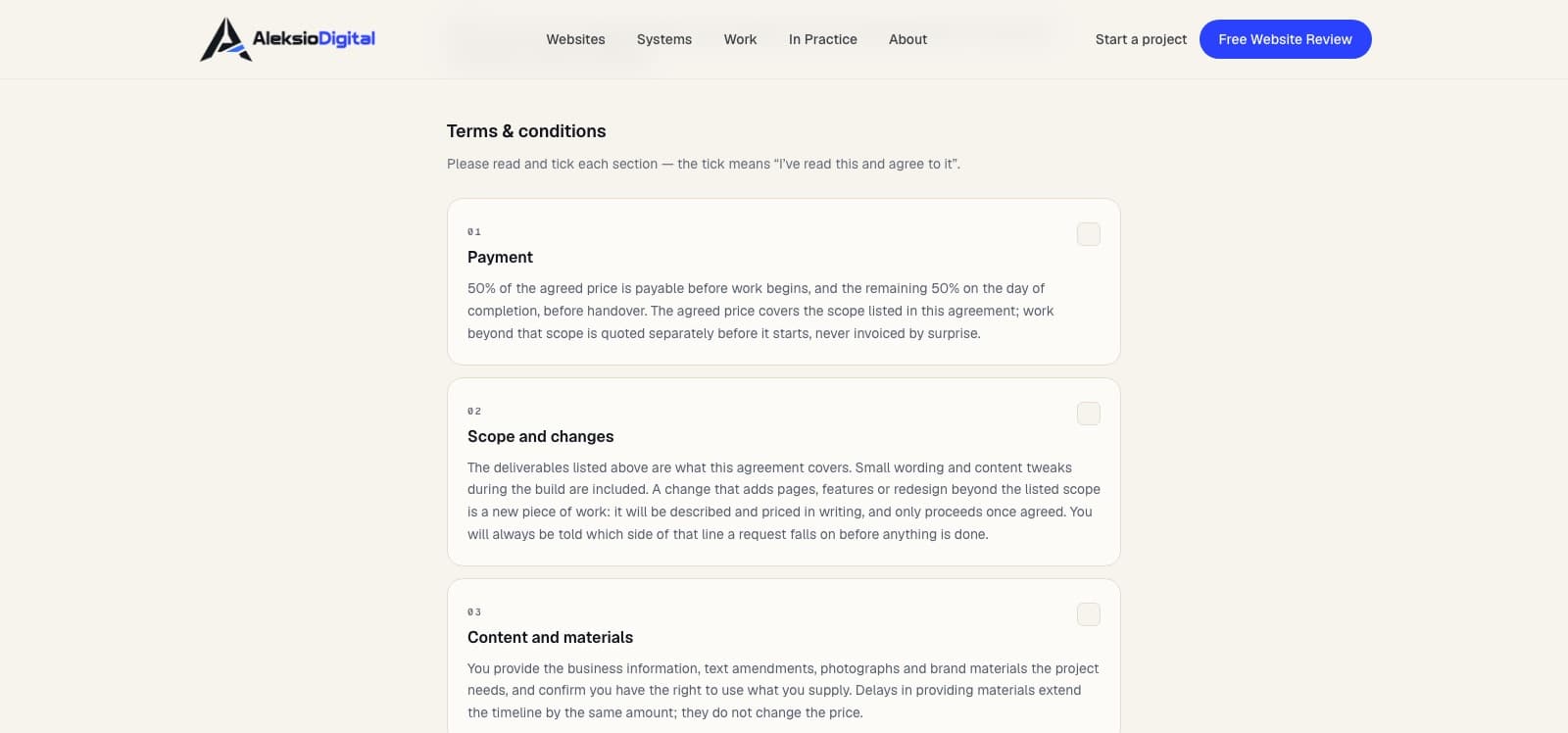
How we sign clients online — and why we built it ourselves.
The proposal-to-deposit system this studio runs on: a link the client ticks and signs on their phone, a branded PDF to both inboxes, the deposit paid by card. What it does, what it deliberately doesn't, and why we didn't just subscribe to DocuSign.
How much does a website cost in Scotland?
Real numbers for what a small-business website costs in Scotland in 2026 — published prices, the costs people forget, and the questions worth asking anyone.
Want this applied to your site?
A Free Website Review is a straight assessment of what’s working, what isn’t, and what to fix first. No obligation.