
Removals & logistics
Websites and quote systems for removals companies.
Every removals enquiry is a survey waiting to happen. The question is whether it happens on your website at eleven at night, or in a van across town on a Tuesday.
What actually makes this hard.
Pricing a move means knowing what is being moved, from where, to where, up how many flights, with what parking, on what date. Traditionally that means a phone call and then a home visit — an hour of driving to quote a job that might not convert, repeated for every enquiry that comes in.
Meanwhile the customer is comparing three or four firms in an evening. The one that gives them a sensible answer first, without making them arrange a visit to find out roughly what it costs, has a considerable advantage over the one that says “call us for a quote”.
The work is also seasonal and dated. Someone moving on the 28th is not a lead to nurture for three months; they need an answer this week, and a site that treats every enquiry the same wastes both of you.
Built for this industry
A real one, live, documented in full.
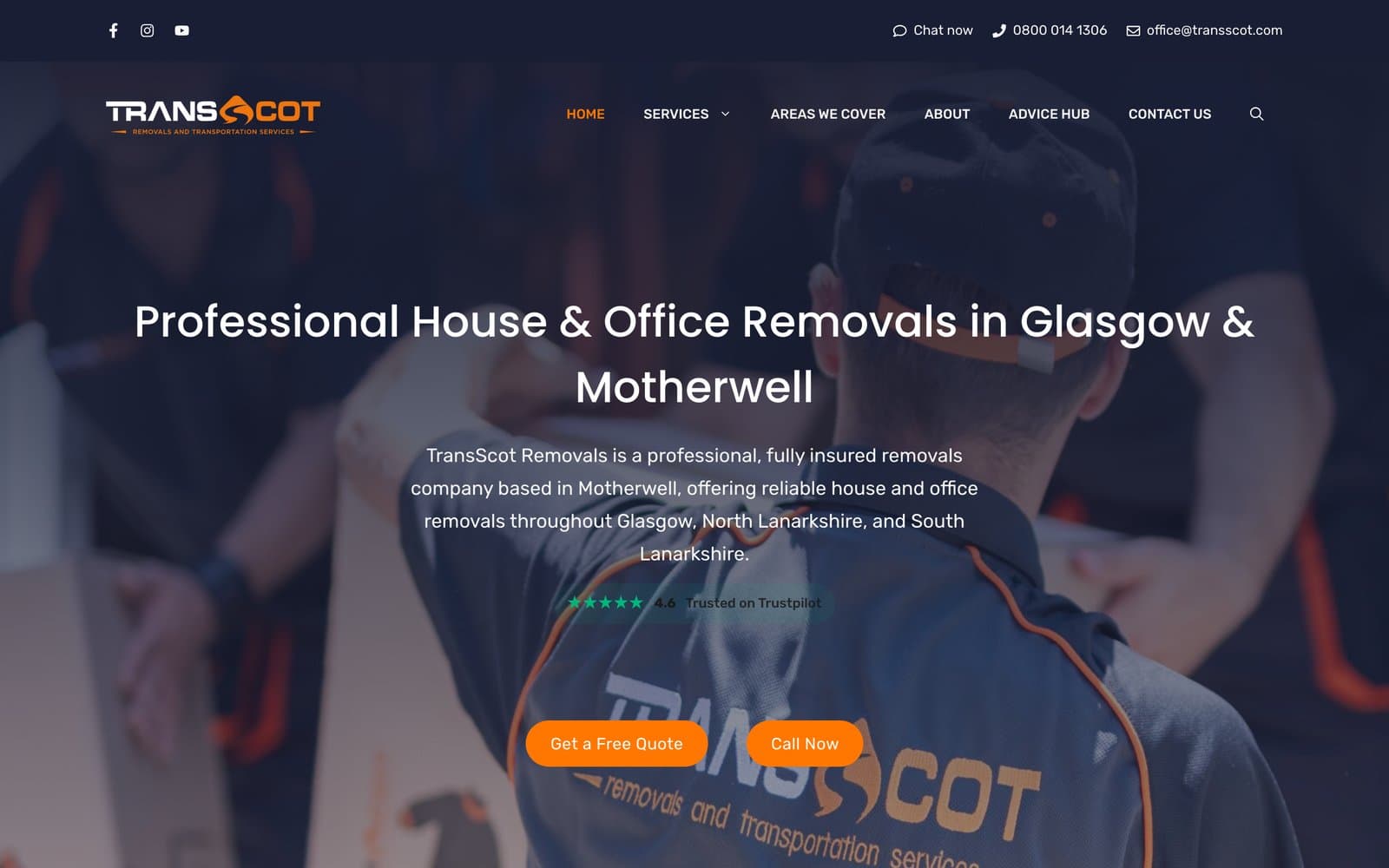
A Glasgow and Lanarkshire removals company, with a website paired to a custom quoting and video-survey system.
What these projects need
The parts that tend to earn their place.
- 01A staged quote, not a contact form
- Break the survey into steps a customer can actually complete — property size, access, dates, inventory. Ask in the right order and people finish; ask everything at once and they leave.
- 02Remote surveying
- Video upload, a cloud link, or a scheduled WhatsApp walkthrough. A customer showing you the wardrobe is worth more than any dropdown, and costs neither of you a journey.
- 03Address and access capture
- Postcode lookup at both ends, floors, lifts and parking. Access is what turns a two-hour job into a five-hour one, and it belongs in the quote rather than the surprise.
- 04Dates that mean something
- A move date is a hard constraint, not a preference. Capturing it early lets you triage a diary instead of a mailbox.
- 05Trust, visibly
- People are handing strangers everything they own. Real photographs of real vans and real crews do more than any strapline about care and professionalism.
Not every project needs all of this. Which parts earn their place is what the first conversation is for — and the honest answer is sometimes that a straightforward website is enough. Here’s how to tell.
Before you ask
The questions that usually come next.
Straight answers on time, money and what you end up owning.
See all the questions01How long does it take?
A smaller website is usually about a week, measured from the point everything is ready — your text, photos and any brand assets in hand. Custom systems like booking or quoting tools take up to four weeks. In practice the honest variable is how quickly content comes back; that stretches timelines far more often than the build does.
02How does payment work?
Half up front to start the work, and the remaining half on the day the site goes live. Nothing in between, and no charges you haven't already seen on the quote. Ownership transfers with that final payment.
03Do I own the website?
Yes — outright, on final payment. That covers the design, the code written for your project and your content. Your domain is registered in your name, so you control the address itself and can take it elsewhere whenever you like. The underlying open-source frameworks stay under their own licences, as they do for any website. The only thing kept back is the right to show the work here as a case study.
04Can I update the site myself?
Sites here are hand-built rather than assembled in a page builder, so there is no admin panel by default — changes come through me. Small tweaks are covered by the care plan, and where you'll be updating something regularly, I build a proper interface for exactly that. If managing all your own content day to day matters to you, say so at the start: it's a reasonable thing to want, and it changes how the site should be built.
05What does hosting cost after the first year?
The first year of hosting is included. After that it's £65 a year for hosting on its own, or £180 a year for a care plan — hosting plus small tweaks and ongoing updates as you need them. Your domain renews separately and stays registered in your name. There's no obligation to take either: you own the site and can host it wherever you want.
06Do you outsource the work?
No. Every project is handled directly by George, from the first conversation through to launch. There's no account manager in between and no work passed to a third party.
Not your trade?
Tell us how the work actually comes in.
What happens between an enquiry arriving and a job being priced is usually where the useful work is. Describe that and we’ll come back with a scope and a straight answer on cost.