Schools & community organisations
Websites for schools and community organisations.
A community organisation has two audiences at once: the families and members inside it, and the funders, partners and newcomers looking in. The website has to speak to both — often in two languages — and the admin behind it has to run on volunteer time.
What actually makes this hard.
Enrolment and registration is usually the first thing to break. Paper forms, a shared inbox and a spreadsheet work until the year the numbers grow — then people fall through the gaps, and the person holding it all together is a volunteer with a day job.
The second problem is language. A Bulgarian, Polish or Arabic-speaking community needs its own language first — that is the entire point of the organisation — but the local authority, funders and prospective partners read English. A site that does one badly for the sake of the other loses half its audience.
The third is that the organisation's real life happens on Saturdays and evenings, in photographs and news, and most community websites go stale within a term because updating them is nobody's job.
Built for this industry
A real one, live, documented in full.
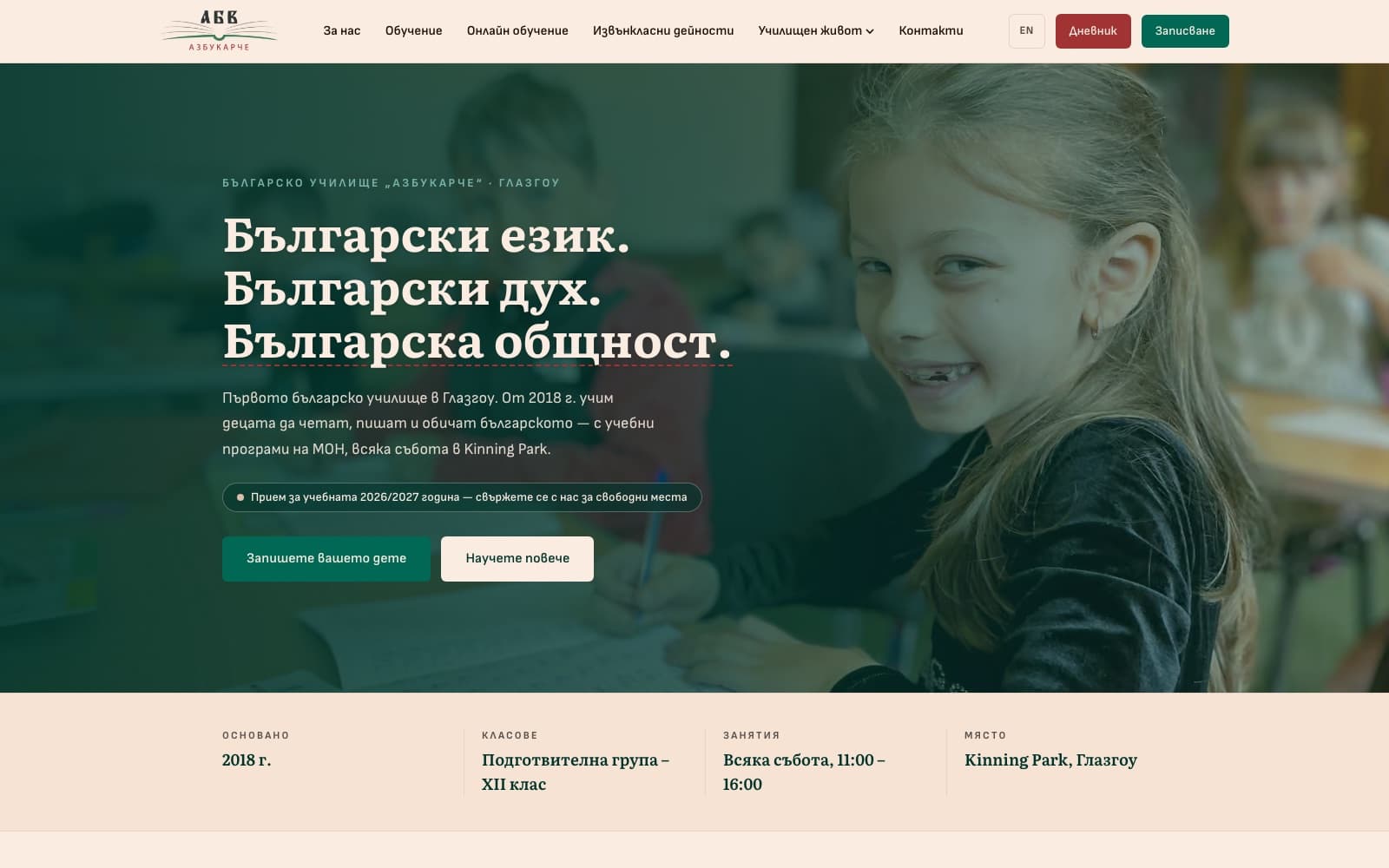
Glasgow's first Bulgarian school — a bilingual public website with online enrolment, and behind it the Electronic Diary system we built first.
What these projects need
The parts that tend to earn their place.
- 01A genuine bilingual structure
- Every page in both languages with its own URL — not a translation widget bolted on. The community's language first; English complete, indexable and equally cared for.
- 02Online enrolment that replaces the paper
- A structured form parents complete in minutes, with the fee terms stated beside it and an honest notice when a deadline has passed. Applications arrive as data, not as a photograph of a form.
- 03News, gallery and team pages that stay alive
- Achievements, events and photographs of the actual Saturdays — structured so a volunteer can add to them without breaking anything, and so the site reads as a living organisation rather than a brochure.
- 04The internal system behind the public site
- Attendance, teacher and student dashboards, a library catalogue — the tools that run the organisation belong in one place, with one login per role, and a door to them from the public site.
- 05Ownership that survives committee changes
- Domain, hosting and accounts in the organisation's name, documented, with no single volunteer as the point of failure. Community organisations outlive their founders; their websites should too.
Not every project needs all of this. Which parts earn their place is what the first conversation is for — and the honest answer is sometimes that a straightforward website is enough. Here’s how to tell.
Before you ask
The questions that usually come next.
Straight answers on time, money and what you end up owning.
See all the questions01How long does it take?
A smaller website is usually about a week, measured from the point everything is ready — your text, photos and any brand assets in hand. Custom systems like booking or quoting tools take up to four weeks. In practice the honest variable is how quickly content comes back; that stretches timelines far more often than the build does.
02How does payment work?
Half up front to start the work, and the remaining half on the day the site goes live. Nothing in between, and no charges you haven't already seen on the quote. Ownership transfers with that final payment.
03Do I own the website?
Yes — outright, on final payment. That covers the design, the code written for your project and your content. Your domain is registered in your name, so you control the address itself and can take it elsewhere whenever you like. The underlying open-source frameworks stay under their own licences, as they do for any website. The only thing kept back is the right to show the work here as a case study.
04Can I update the site myself?
Sites here are hand-built rather than assembled in a page builder, so there is no admin panel by default — changes come through me. Small tweaks are covered by the care plan, and where you'll be updating something regularly, I build a proper interface for exactly that. If managing all your own content day to day matters to you, say so at the start: it's a reasonable thing to want, and it changes how the site should be built.
05What does hosting cost after the first year?
The first year of hosting is included. After that it's £65 a year for hosting on its own, or £180 a year for a care plan — hosting plus small tweaks and ongoing updates as you need them. Your domain renews separately and stays registered in your name. There's no obligation to take either: you own the site and can host it wherever you want.
06Do you outsource the work?
No. Every project is handled directly by George, from the first conversation through to launch. There's no account manager in between and no work passed to a third party.
Not your trade?
Tell us how the work actually comes in.
What happens between an enquiry arriving and a job being priced is usually where the useful work is. Describe that and we’ll come back with a scope and a straight answer on cost.