
How much does a website cost in Scotland?
Almost nobody in this industry will answer that question in writing. Here's an actual answer, with the numbers this studio charges — and the parts of the bill people only discover later.
Search for website prices and you'll mostly find the same ritual: "every project is different, book a discovery call." Every project is different — and it's still possible to publish where the numbers start, because a builder can tell you roughly what an extension costs before visiting your house. So here are ours, followed by the more useful part: what moves them, and what the quotes you gather elsewhere may quietly leave out.
The short answer
- A starter website — from £595. A small number of pages, done properly, for a business that needs to look credible and be found.
- A business website — from £895. A fuller site with the structure to explain a broader offer, built around how your customers compare and decide.
- A lead-generation website — from £1,295. Designed around enquiries: clear conversion paths, stronger content structure, and measurement to keep improving it.
- A custom system — quoted individually. Booking, quoting, portals, automation. These are scoped against what the system actually has to do, and take up to four weeks.
Those are this studio's published starting points, and they're on the homepage, not hidden in a PDF. Other studios will differ — some charge less, plenty charge several times more — but the shape is common across the industry: a few hundred pounds for small and simple, four figures once the site has a job to do, and individual quotes once software is involved.
What actually moves the price
It isn't the number of pages, mostly. Ten pages using the same layout are barely more work than four. What moves the number is:
- How many things need designing. Every genuinely different kind of page — a homepage, a service page, a case study — is a design decision. Repeats of an existing kind are cheap.
- Whether the site has to do something. The moment customers need to book, get a price, upload photographs or log in, you've crossed from website into system, and the cost reflects that the thing has to work every time, for strangers, unattended.
- How ready your content is. Text and photographs that exist keep a project at its quoted price and a one-week timeline. Content that has to be chased or created is where budgets and schedules actually go.
- Who's doing it. A large agency carries account managers, offices and juniors on your invoice. A single experienced person carries none of those — which is a genuine reason smaller can be cheaper and better, not a corner being cut.
The costs people forget to ask about
The build price is the visible half. The rest of the bill arrives annually, and it's where the industry hides its mischief:
- The domain — typically ten to twenty-odd pounds a year, renewing for as long as you trade. Small money, big principle: whoever is named as registrant legally owns your address.
- Hosting — here, the first year is included, then £65 a year. Elsewhere this ranges from a few pounds monthly to eyebrow-raising "managed hosting" fees, so ask what it is and what it covers.
- Upkeep — our care plan is £180 a year including small tweaks and updates. The equivalent elsewhere is often a monthly retainer; whatever the number, ask what a small text change actually costs, because that's the one you'll want most often.
How payment usually works
Here it's half up front and half on the day the site goes live, with ownership — design, code, content — transferring on that final payment. Fifty-fifty is common across the industry and it's a fair shape: both sides carry half the risk. What varies more is the ownership question, and it's worth settling in writing before any money moves: some firms licence you the site rather than sell it, and rolling contracts with notice periods are common enough that "what happens if I want to leave?" belongs in your first conversation, not your last.
So what should you actually pay?
It depends on what the site is for — which sounds like the dodge this article exists to avoid, so here it is as a decision instead:
- If you need to exist credibly — customers check you out before calling — the starter tier does that job. Paying four figures for it buys polish you may not need yet.
- If the site has to explain and persuade — you sell something considered, against competitors — you're in business-site territory, and the extra buys structure, not decoration.
- If the site's job is enquiries you can count — you'd measure it in leads per month — the lead-generation tier is what that costs done properly, and cheaper versions of it tend to be a brochure with a form.
- If your real problem is quoting, booking or admin, stop pricing websites — you need a system, and the website is the front door to it.
One honest addition: sometimes the right amount to spend is nothing yet. If you have a site already, it may be one fixable problem away from working — that's exactly what the Free Website Review is for, it costs nothing, and if a £595 rebuild isn't justified we'll say so.
More from In Practice
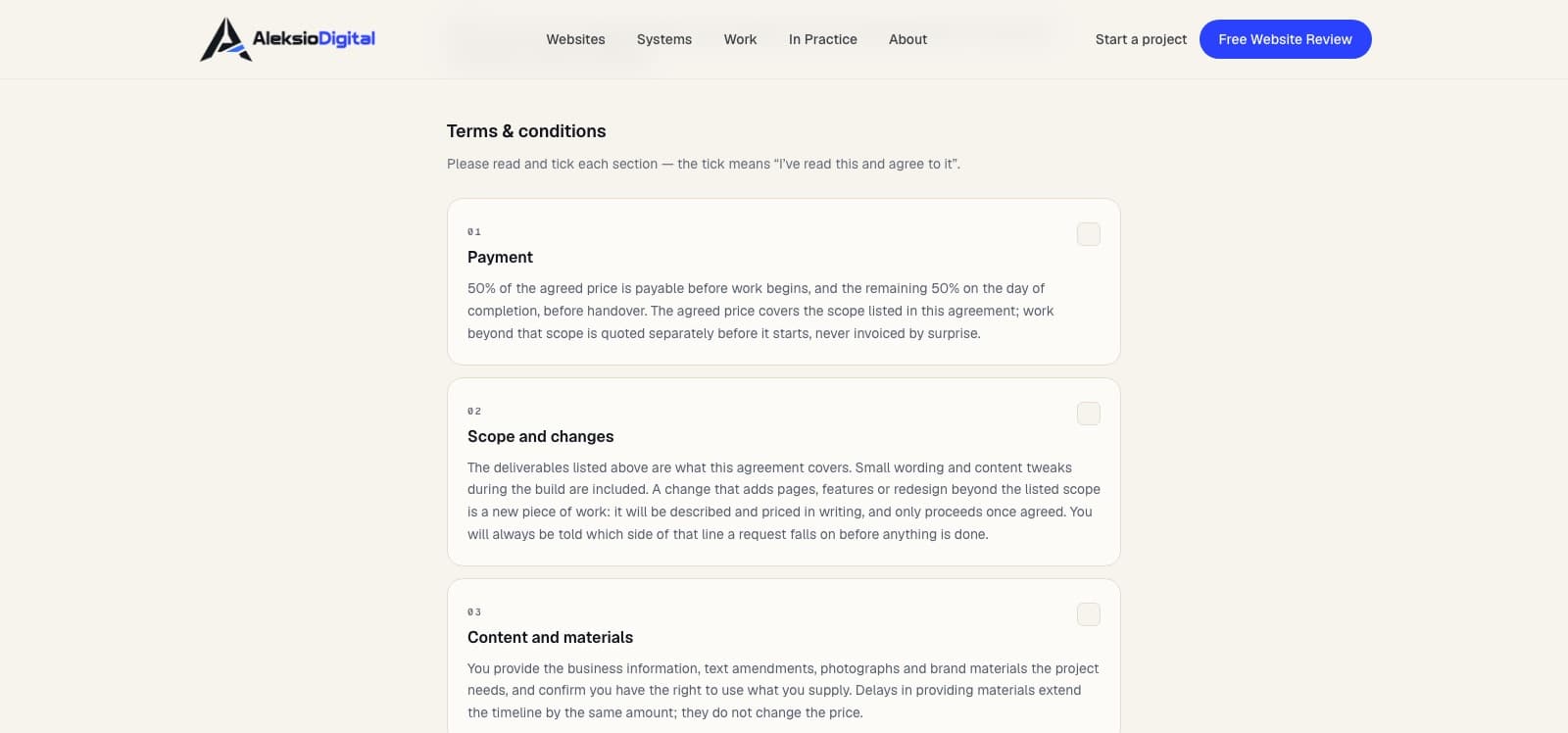
How we sign clients online — and why we built it ourselves.
The proposal-to-deposit system this studio runs on: a link the client ticks and signs on their phone, a branded PDF to both inboxes, the deposit paid by card. What it does, what it deliberately doesn't, and why we didn't just subscribe to DocuSign.
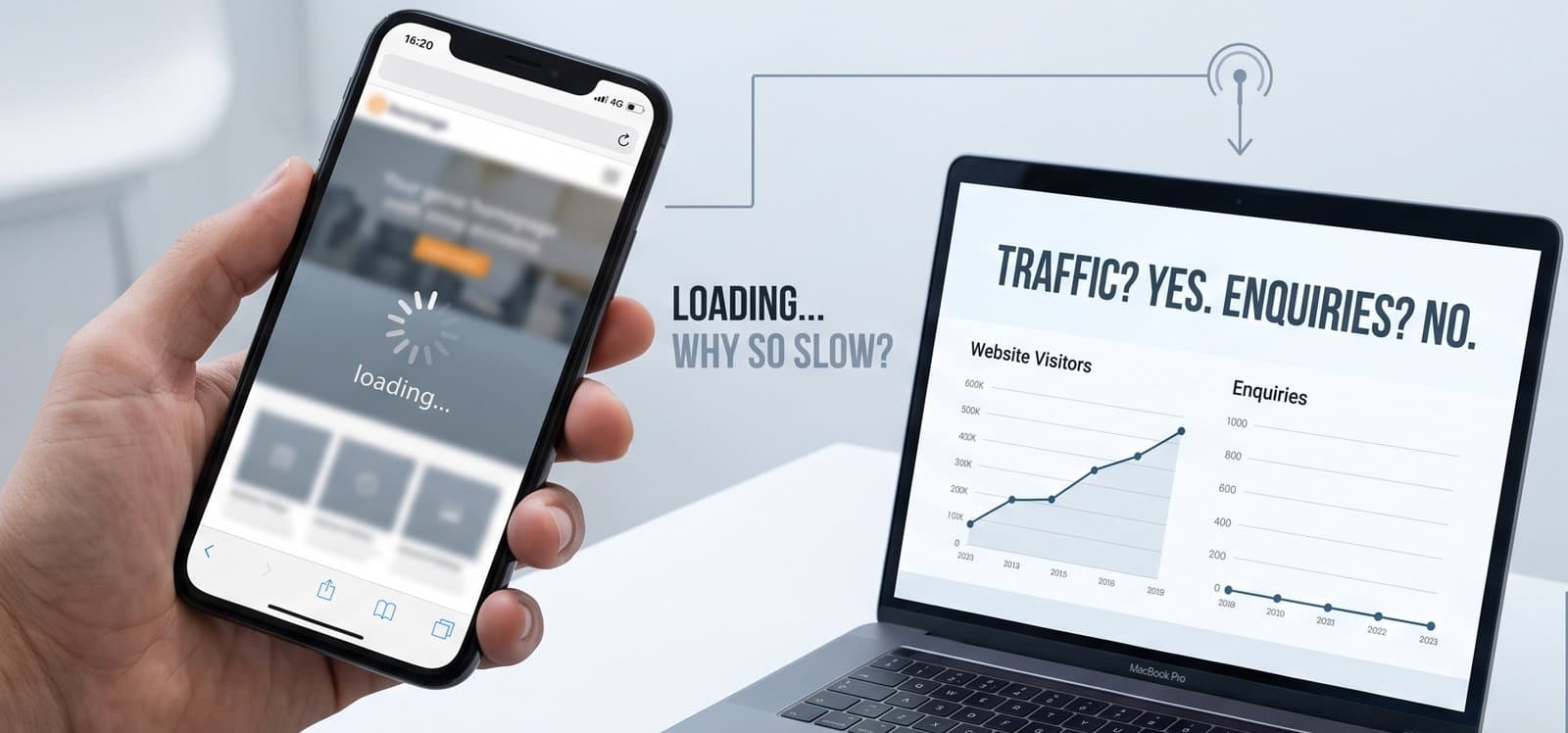
Your website gets visits but no enquiries. Here's where it usually goes wrong.
Traffic without enquiries is rarely a traffic problem. The things that quietly stop a small business website converting — and what to check first.
Want this applied to your site?
A Free Website Review is a straight assessment of what’s working, what isn’t, and what to fix first. No obligation.