What you actually need ready before a website build starts
A small business website takes about a week to build. Plenty take three months, and the extra time is almost never spent building.
It's spent waiting. For the text. For photographs. For a decision about what the business actually wants the site to do. None of that is anyone's fault — it's just that the work gets scheduled as though it happens in parallel with the build, and it doesn't.
So here's the honest list. Not a demand for a full brand book, just the things that, if you have them, remove almost all the delay.
One sentence about what the site is for
Not the design brief. The business one. "I want more enquiries for commercial jobs, not domestic." "I want to stop answering the same three questions on the phone." "I want to look credible enough to be shortlisted for bigger contracts."
This is the single most useful thing you can bring, and it's the one most often skipped. Every later decision — what goes first on the homepage, what the main button says, whether you need a system at all — gets easier once it's written down.
Your text, roughly
Rough is fine. Written in an email at eleven at night is fine. What you don't want is to be writing it during the build, because that's the thing that stretches a week into six.
What's usually needed:
- A short description of the business — what you do, who for, where.
- Your services, with a couple of sentences each.
- Something about you or the team, however brief.
- Contact details, opening hours, and the areas you cover.
If writing isn't your thing, say so early. It's a normal thing to need help with. It's much less normal — and much more expensive — to discover it halfway through.
Photographs — real ones
This is where the biggest difference between an average site and a good one gets made, and it has almost nothing to do with the design.
Photographs of your actual work, your actual premises, your actual team will beat stock photography every time, even when the stock photography is technically better. People recognise the difference immediately, even if they couldn't tell you why. Phone photographs in decent daylight are genuinely fine.
Your logo, if you have one
Ideally the original file from whoever made it — an SVG, AI, EPS or PDF. Those scale to any size cleanly. A small PNG lifted from an old website will look soft on modern screens, and there's no way to sharpen it after the fact.
If you don't have a logo, that's not a blocker. It just needs to be a conscious decision rather than something discovered on launch day.
Access to the things that already exist
If you already own a domain, you'll need to be able to get into the account that controls it. This is the single most common source of last-minute delay: the domain was registered years ago, by someone who has since left, using an email address nobody can access.
Worth checking now rather than on the day the site is ready to go live. The same goes for any existing hosting, and for a Google Business Profile if you have one.
What you don't need
A few things people worry about that genuinely don't matter at this stage:
- A finished idea of how it should look. That's the part being designed for you.
- A sitemap or page structure. That comes out of the first conversation.
- A decision about hosting. It's included for the first year either way.
- Perfect final wording. Text gets edited before launch as a matter of course.
The shortest version
One sentence about what the site is for, rough text for your main pages, real photographs, your logo file, and access to your domain. That's the difference between about a week and about three months — and it's almost entirely within your control.
If you'd rather just start talking and work the rest out together, that's fine too. Tell me about the project and we'll go from there.
More from In Practice
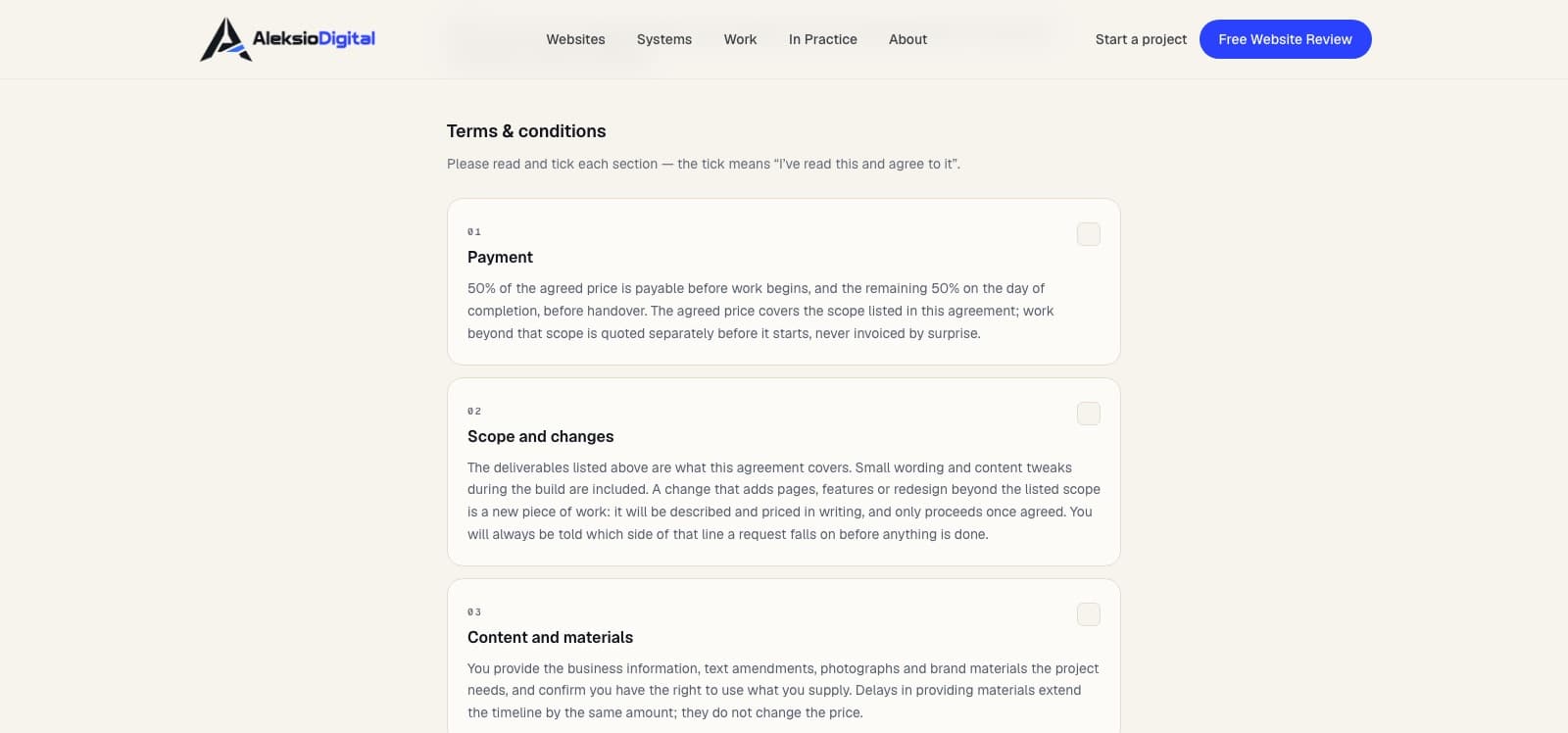
How we sign clients online — and why we built it ourselves.
The proposal-to-deposit system this studio runs on: a link the client ticks and signs on their phone, a branded PDF to both inboxes, the deposit paid by card. What it does, what it deliberately doesn't, and why we didn't just subscribe to DocuSign.
How much does a website cost in Scotland?
Real numbers for what a small-business website costs in Scotland in 2026 — published prices, the costs people forget, and the questions worth asking anyone.
Want this applied to your site?
A Free Website Review is a straight assessment of what’s working, what isn’t, and what to fix first. No obligation.